
Even if you have the right qualifications, preparing for a job interview can be tough. You might know the answers but still struggle to explain them clearly, stay organised, manage nerves, or handle surprise questions.
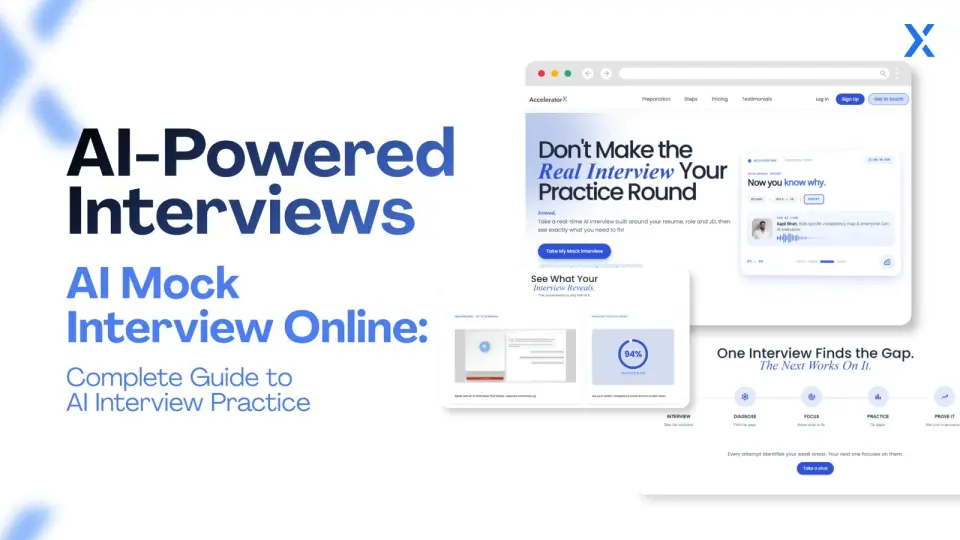
An online AI mock interview is a practical way to prepare before your real interview. Instead of only reading questions, you can answer them out loud, act out real interview situations, and get feedback on your performance.
AI interview practice can help you prepare for HR, technical, behavioural, coding, managerial, and other job-specific interviews. The AI can generate questions that match your resume, the job description, your experience, and the role you want.
You can take AI mock interviews as often as you need. Each session helps you spot weak answers, improve how you communicate, organise your responses, and build confidence.
What Is an AI Mock Interview?
An AI mock interview is a practice job interview with artificial intelligence. The AI acts like an interviewer, asks questions based on your target job or description, reviews your answers, and gives feedback to help you improve before the real thing.
Unlike just reading a list of questions, an AI mock interview gives you a more interactive way to practice. Depending on the platform, you might answer by typing, speaking, or recording a video.
This kind of practice feels far more realistic than reading sample answers from static cheat sheets. Most modern AI interview platforms offer personalised questions, practice based on your resume or job description, mock sessions, and actionable AI feedback.
How Does an AI Mock Interview Online Work?
The procedure can vary by platform, so choose one that works for you. When comparing AI mock interview tools, look at the price, features like video recording and feedback, and what other users say. Checking these things helps you find the best fit. To keep the process clear, an online AI mock interview usually follows five main steps:
Start by choosing the position you want to prepare for. Choosing a specific role makes the interview questions more relevant to your goals:
AI interview platforms allow you to upload your resume and paste the job description. The AI parses key parameters to craft tailored questions:
The AI interviewer asks questions one at a time. Depending on the platform, you can respond via Voice, Video, Text, or Audio recording. Voice and video practice are especially helpful because real interviews require you to articulate your answers out loud.
After concluding the interview, you receive instantaneous multi-dimensional scoring across key criteria:
Why Use AI Interview Practice?
Reading interview questions helps you know what to expect, but knowing an answer and saying it well are two completely different things.
AI interview practice lets you actually say your answers out loud before the real interview. You can use it to identify common communication roadblocks such as:
💡 Real Example: You might believe your response to “Tell me about yourself” is stellar because it spans your education, internships, hobbies, and achievements. But after recording yourself, you realize it drags on for 4 minutes and touches on points unrelated to the job. AI feedback immediately flags this, enabling you to trim it down to an impactful 90 seconds.
Benefits of an AI Mock Interview Online
No need to align schedules with friends or mentors. Practice before work, late at night, on weekends, or 30 minutes before your actual interview.
No waiting days for someone to review your notes. Get instant line-by-line feedback while the session is still fresh in your mind.
Tailored to Software Engineering (data structures, system design) or Digital Marketing (SEO, ROAS, Google Ads, analytics) without generic fluff.
Desensitize yourself to interview anxiety through repetition. Answering out loud converts stressful situations into comfortable routines.
AI platforms help you hone behavioural answers using the proven STAR framework:
Types of AI Mock Interviews
An AI mock interview does not have to be limited to general HR questions. Modern simulators support specialized practice tracks:
Focuses on common recruiter questions: “Tell me about yourself,” “Why should we hire you?,” “What are your biggest strengths & weaknesses?,” “Where do you see yourself in 5 years?,” “What are your salary expectations?”
Tests depth in your specific tech stack. For software developers: data structures, algorithms, databases, APIs, OOP, and system design. For data analysts: SQL queries, Power BI, Python, stats, and business analytics.
Evaluates past actions under pressure: solving difficult bugs, conflict resolution with colleagues, handling project failure, and demonstrating leadership.
Focuses on articulating algorithmic choices, debugging decisions, time complexity trade-offs, and architecture design out loud.
Adds visual analysis: facial expressions, camera eye contact, posture, speaking cadence, and overall executive presence.
AI Mock Interview for Freshers vs. Experienced Professionals
Freshers often have limited work experience. AI practice helps turn academic achievements into compelling stories:
- Explaining capstone projects with clear problem statements
- Highlighting internship contributions & tech stacks
- Describing leadership in campus clubs or hackathons
- Framing self-taught certifications effectively
Senior professionals need to communicate executive impact, cross-functional leadership, and measurable business ROI:
- Quantifying business impact (revenue, efficiency, churn)
- Stakeholder management & conflict navigation
- Architectural and technical roadmap decisions
- Mentorship and team scaling experiences
How to Prepare for an AI Mock Interview
1. Dissect the Job Description
Extract required tools, responsibilities, years of experience, and industry jargon. Feed this context into your AI tool to align simulated questions with actual employer priorities.
2. Review Every Line on Your Resume
Anything on your resume is fair game. If your bullet point claims “Boosted website traffic by 40%,” be ready to explain the baseline, tools used, channel breakdown, and measurement window.
3. Perfect Your Introduction (Present → Past → Future)
Start with what you do currently, summarize your key past accomplishments, and conclude with why this specific opportunity is your natural next step.
4. Prepare 5 Versatile Anecdotes
Prepare flexible real-world stories covering Leadership, Problem-Solving, Conflict, Failure/Mistakes, and Tight Deadlines.
How to Get Better Results From a Mock Interview With AI
Don't just complete one mock interview and walk away. The true compounding value comes from iterative refinement:
Speak without over-rehearsing to establish a realistic baseline.
Spot recurring patterns in filler words, pace, and lack of metrics.
Trim fluff and inject concrete STAR results.
Retake the session and compare your scorecard improvements.
Practice answering “Why?,” “How did you do that?,” and “What would you change?”
Common AI Mock Interview Questions
General HR Questions
- Tell me about yourself.
- Why are you interested in this position?
- Why should we hire you?
- What are your greatest strengths?
- What is your biggest weakness?
- Why do you want to work for our company?
- Where do you see yourself in 5 years?
- What motivates you?
- Tell me about your biggest achievement.
- Why should we select you over other candidates?
Behavioural Questions
- Tell me about a time you solved a difficult problem.
- Describe a conflict you had with a colleague.
- Tell me about a time you failed and what you learned.
- Describe a situation where you worked under pressure.
- Tell me about a time you demonstrated leadership.
- Tell me about a difficult decision you made.
- Describe a time you had to learn something quickly.
- Tell me about a time you disagreed with your manager.
Technical & Role-Specific Questions
How AI Can Evaluate Your Interview Performance
Did you answer the exact question directly, or wander off into unrelated tangents?
Does your response flow logically using frameworks like STAR or Problem-Solution-Outcome?
Vague: “I improved the campaign.” vs. Strong: “I optimized keyword targeting, raising leads by 28% in 90 days.”
Tracks Words-Per-Minute (aim for 130–160 WPM) and identifies excessive use of “um,” “like,” “basically,” “actually.”
AI Mock Interview Online vs. Traditional Mock Interview
Both methods provide distinct advantages for candidates preparing for competitive positions:
| Feature | AI Mock Interview | Traditional Mock Interview |
|---|---|---|
| Availability | Instant, 24/7 on-demand | Requires calendar alignment |
| Repeated Practice | Unlimited iterations | Limited by mentor time |
| Immediate Feedback | Instant scorecard & analytics | Subjective, delayed notes |
| Job Description Matching | Automated JD & resume analysis | Depends on interviewer prep |
| Cost | Low or Free | High coaching fees |
| Interpersonal Nuance | Moderate | Strong human rapport |
| Practice Frequency | Daily drills | 1–2 sessions before interview |
Is AI Interview Practice Effective & How Many Sessions Should You Take?
AI interview practice is highly effective when treated as a continuous feedback loop rather than a one-time test. A structured 5-session roadmap guarantees steady progress:
Common Mistakes to Avoid During an AI Mock Interview
- Memorising Every Script Word-for-Word: Memorized answers sound robotic and make it difficult to pivot when an interviewer asks an unscripted follow-up. Memorize key bullet points and metrics, not full sentences.
- Giving Generic, Vague Answers: Avoid clichés like “I am a passionate team player.” Always back up statements with quantifiable evidence.
- Ignoring the Specific Job Description: A great answer for an early-stage startup may fall flat at an enterprise firm. Tailor your focus to the company's maturity and tech stack.
- Practising Only in Text Mode: Reading or typing answers uses different cognitive pathways than speaking out loud. Use microphone and camera mode whenever available.
- Treating AI Scores as Absolute Gospel: AI feedback provides incredible structured insight, but human chemistry, cultural fit, and gut judgment still play a role in real hiring decisions.
How to Use AI for Comprehensive Interview Preparation
To maximize your career readiness, implement an end-to-end preparation pipeline:
🚀 Want hands-on AI tools and workflow skills? Master prompt engineering, autonomous agents, and AI automation with AcceleratorX's industry-acclaimed courses. Explore the Generative AI & Agent Engineering Course.
Frequently Asked Questions About AI Mock Interviews
An AI mock interview is a simulated interview where artificial intelligence acts as the interviewer. It asks questions, receives your answers, and provides instant feedback on relevance, structure, communication, and delivery.
Yes. Modern AI interview platforms run directly in your web browser. You can complete interactive sessions via voice, webcam video, or text from any computer or mobile device.
Choose your target role, upload your resume or paste the job description, answer questions out loud, review the line-by-line feedback scorecard, and repeat the session after refining your weak points.
Yes. Freshers can use AI mock interviews to practice articulating college projects, internships, leadership roles, and technical skills with confidence.
AI evaluates multiple measurable factors including answer relevance, STAR framework adherence, metric specificity, filler words, speech pace, and technical keywords.
Yes. Specialized tracks cover technical topics across software engineering (data structures, system design), data analytics (SQL, Power BI), digital marketing, and product management.
Yes. Advanced AI interview tools analyze job descriptions to extract required competencies and dynamically formulate realistic, role-specific questions.
They complement each other. AI offers 24/7 unlimited on-demand practice and objective metrics, while human mock interviews provide culture fit assessment and nuanced industry advice.
Aim for 3 to 5 focused sessions before an upcoming interview. Focus on improving specific weak answers between iterations.
Review your feedback report, identify your top 2 or 3 weakest responses, rewrite them with concrete quantifiable results, and take another mock session.
Yes. Repeated spoken practice reduces filler words, stabilizes speaking pace (130–160 WPM), eliminates awkward pauses, and improves clarity.
No. Use AI to understand answer structure and delivery pacing, but ensure your final answers represent your genuine, authentic personal achievements.
Final Checklist Before Your Real Interview
Before attending your real job interview, ensure you can confidently answer:
Conclusion: An online AI mock interview is a convenient, low-pressure way to practice before a high-stakes job interview. Instead of passive reading, you can simulate the environment, speak your responses out loud, receive instantaneous feedback, and systematically polish weak answers. The better you can articulate your skills, decisions, and achievements under pressure, the more confident and prepared you will be when you meet the hiring manager.
Simulate real-world technical and behavioural interviews, get instant feedback scorecards, and land your dream job in tech and AI.